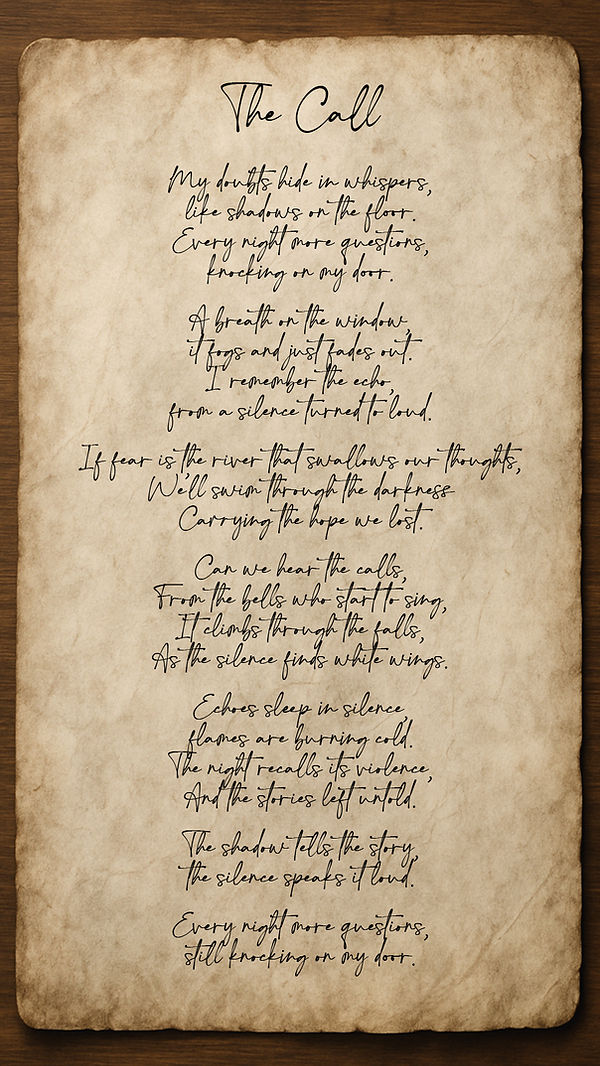
The Call
Video Description
At the moment the song whispers “A breath on the window,”
the video shows Morgan walking through the golden wheat of his past.
This memory appears like a breath on cold glass — warm, sudden, fleeting.
It represents the life he once had, the man he was before the war,
a fragile moment that glows for a heartbeat and then fades back into the cold.
This is the emotional oxygen of the video: the reminder that behind the uniform stands a man who once knew peace.
During the line “I remember the echo,” the video shows Cemetery Hill untouched by war — quiet, peaceful, and still.
The hill is the echo: a place that remembers everything even when nothing is happening.
By showing it without violence, the scene becomes a memory of what the land once was, a fragile moment before history scarred it.
This is not the battlefield—this is the echo of the battlefield, the silence beneath the noise, and the weight of what Morgan carries inside.
For the line “from a silence turned to loud,” the video cuts to a cannon firing at Gettysburg.
The cannon blast is the exact moment when peace shatters and the world becomes violent.
It transforms silence into explosive sound, symbolizing the instant Morgan’s life was torn from quiet innocence into the chaos of war.
The smoke, the shockwave, and the roar of the cannon visually express the lyric’s meaning: the eruption of trauma, the breaking of memory, and the end of silence.
For the line “If fear is the river that swallows our thoughts,” the video shows a formerly enslaved man walking through deep winter mud, a shackle still locked around his ankle.
The mud becomes the river of fear — heavy, consuming, pulling him down with every step.
The shackle symbolizes the past that still clings to him, a reminder that fear was not abstract but physical, life-threatening, and constant.
This scene embodies the lyric’s meaning: fear as a force of nature that swallows thought, dignity, and hope.
By walking forward, he represents courage in its purest form — moving through fear, not away from it.
For the line “We’ll swim through the darkness, carrying the hope we lost,” the video shows four formerly enslaved men walking toward the Union camp.
Their steps through the winter fog and mud represent the darkness they must cross to reach freedom.
Though exhausted and unsure of what awaits them, they carry a fragile, powerful hope — the hope that was once taken from them.
This scene transforms the lyric into a universal truth: freedom begins in uncertainty, and courage is found not in the absence of fear, but in the decision to move forward despite it.
For the line “Can we hear the calls, from the bells who start to sing,” the video shows a lone Liberty bell standing in a field of fallen soldiers.
This is more than a symbol of memory — it is the moment the North was called to rise against slavery.
The bell’s song becomes the voice of conscience, summoning a nation to confront injustice and defend human dignity.
Surrounded by corpses, the bell stands as a reminder that the fight for freedom carried a heavy cost.
The question “Can we hear the calls?” becomes a moral challenge: do we understand the sacrifice made to end slavery and protect the hope of those who had none?
For the lines “It climbs through the falls, as the silence finds white wings,” the video shows Union soldiers marching toward the battlefield, followed by a close shot of the white wings symbol on the drummer’s instrument.
The soldiers represent hope climbing through danger — the North advancing through the roar of war.
The white wings symbolize salvation for those who suffered under slavery, a promise that freedom was coming.
Together, these scenes show the Union army as the moral force rising through chaos, answering a call greater than themselves.
The silent suffering of millions finally finds its wings through the march of those who came to free them.
For the line “Echoes sleep in silence,” the video reveals a calm, quiet cotton field at dawn.
At first glance it looks peaceful, but this silence hides centuries of suffering.
The empty field becomes a haunting echo — a place where millions endured pain that the land still remembers.
No one appears in the shot; the absence itself speaks louder than any reenactment could.
The scene symbolizes the hidden weight beneath the surface of history, a reminder that behind the quiet lies a past that shaped the nation and the meaning of The Call.
For the line “flames are burning cold,” the video shows a Black woman running through a cotton field, trying to escape.
She becomes the flame in the lyric — a desperate fire of courage and fear burning inside a place that symbolizes centuries of suffering.
The cotton field looks calm, but its silence hides a cold history of pain.
Her inner fire burns fiercely, yet the world she runs through offers no warmth or safety.
This moment honors the strength of those who risked everything to break free, revealing the emotional truth behind the lyric: courage can burn even in the coldest place.
For the line “The night recalls its violence,” the video shows a silhouetted scene of a man with a whip confronting a Black woman.
Nothing graphic is shown; the moment is presented only as shadows and memory.
This symbolizes the violence that once lived in the night — the fear, danger, and oppression that enslaved people endured in silence.
The scene reflects not the act, but the weight of the past: the night remembers what history tried to hide.
It honors the truth without exploiting suffering, revealing the dark echoes that still shape the world of The Call.
For the line “And the stories left untold,” the video shows a solitary tombstone near a tree and a quiet view of the plantation.
A small torn piece of the woman’s dress hangs from a branch — the last trace of a life full of fear, courage, and silence.
These images represent the countless voices erased by history: people who lived, suffered, fought, and died without their stories ever being heard.
The tombstone stands for the lives that ended without justice, and the plantation symbolizes the world that silenced them.
The rag of fabric becomes a fragile reminder that even when stories go untold, their echoes remain.
When the lyric “Can we hear the calls, from the bells who start to sing” returns, the video shows the Liberty bell for the second time — now glowing brighter, stronger, and more alive than before.
The first bell was a lament in a field of fallen soldiers, a reminder of the cost of freedom.
The second bell is the awakening: the moment justice rises, hope strengthens, and the call becomes unmistakable.
Its stronger glow symbolizes the North’s growing resolve to confront slavery, the collective voices of the oppressed, and the moral force gathering behind the cause of freedom.
The bell is no longer just remembering — it is calling.
When the chorus repeats — “It climbs through the falls, as the silence finds white wings” — the video shifts from marching soldiers to active combat in a forest.
The chaos of gunfire and smoke becomes the “falls,” a storm of danger through which courage must climb.
This time, hope is no longer advancing — it is fighting.
The white wings reappear on the drummer’s drum, symbolizing the spiritual purpose behind the battle: the Union army becoming the force that defends freedom and answers the silent suffering of millions.
The reprise transforms the line into a battle hymn, revealing that justice is not only carried forward — it is earned through sacrifice.
For the bridge lines “The shadow tells the story, the silence speaks it loud,” the video cuts to a close-up of Abraham Lincoln, with the words appearing on his lips.
This moment symbolizes the truth at the center of the Civil War — the hidden suffering and silenced voices of enslaved people.
Lincoln stands in shadow because he carries the weight of that history, and his illuminated words reveal the moral awakening that pulled a nation into conflict.
No figure is better suited to speak this truth: he became the voice for those who were never allowed to speak.
In this scene, history itself breaks its silence, and The Call reaches its deepest meaning.
In the final reprise of “Can we hear the calls, from the bells who start to sing,” the video reveals the Liberty bell inside the old wooden church, glowing softly in the darkness.
This is the most intimate version of the bell — no longer standing on a battlefield or calling armies into action, but speaking directly to the human heart.
Inside the church, the bell represents conscience, truth, and the inner voice that remembers the cost of freedom.
Its glow symbolizes a call that never fades: a spiritual awakening, a reminder that justice and dignity must be carried within us.
This moment transforms The Call from a historical story into a deeply personal one.
For the line “It climbs through the falls, as the silence finds white wings,” the video shows a raven transforming into white birds that rise above a roaring waterfall.
The raven represents the darkness of the past — the suffering, violence, and fear that shaped the world of the song.
When it bursts into white birds, the transformation symbolizes liberation, hope, and the voices that were once silenced now finding flight.
The birds soaring above the waterfall show hope rising through chaos, courage overcoming fear, and the spirit of freedom ascending beyond the violence of history.
This moment is the spiritual heart of the video, where darkness becomes light.
Contact
I'm always looking for new and exciting opportunities. Let's connect.
123-456-7890